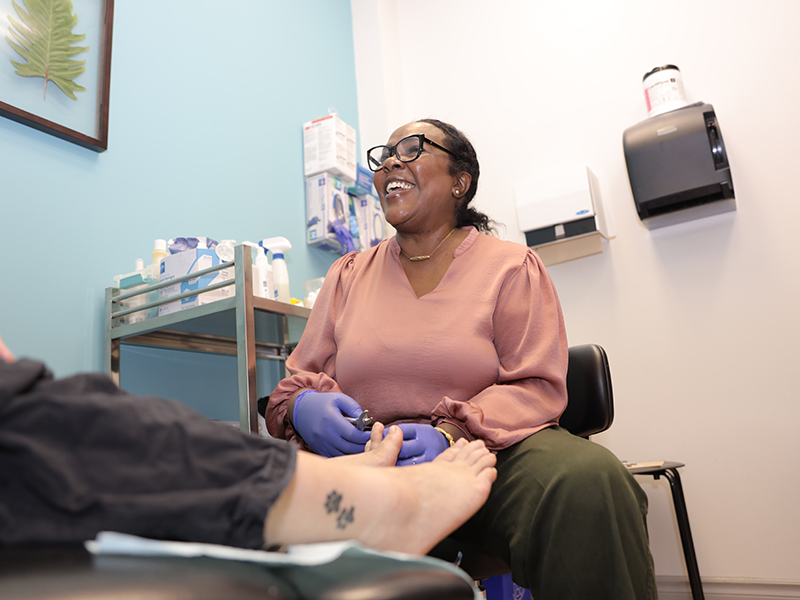
This year, we expanded our foot care program to better support people in our community who are experiencing homelessness — many of whom are also living with diabetes, substance use, and mental health challenges.
Foot health is critical to overall well-being. People living with diabetes can experience reduced feeling in their feet and slower healing due to poor circulation, meaning small cuts or pressure points can go unnoticed and quickly become serious. For those experiencing homelessness, long days on their feet, damp conditions, and worn or ill-fitting shoes greatly increase the risk of wounds, infection, and even limb loss.
Foot screening has long been part of our routine diabetes care. Our teams work closely with each person to assess risk and connect them to the right supports, including chiropody and wound care, helping to ensure timely and appropriate care. This work is informed by our Foot Health Work Group — a cross-organizational team of chiropodists, nurses, and the coordinator of information management. Their efforts are aligned with the Registered Nurses Association of Ontario’s Best Practice Spotlight Organization program, ensuring care is consistently grounded in evidence-based best practices.
This year, we strengthened our focus on prevention by improving access to proper footwear. With support from the Downtown East Ontario Health Team and a partnership with Mark’s, people get a “prescription” that gives them access to free, well-fitted shoes and boots that keep their feet warm and dry — a simple but important way to reduce risk. Each person is assessed for fit, guided in their selection, and supported through ordering and delivery when needed.
For many of our clients, this small intervention makes a meaningful difference — helping preserve their mobility and making their daily life a little easier.
By the numbers:
97
clients served by the new foot care program with shoes/boots fitted and provided
36%
of clients were underhoused or experiencing homelessness
93%
of clients have an annual household income of less than $40,000