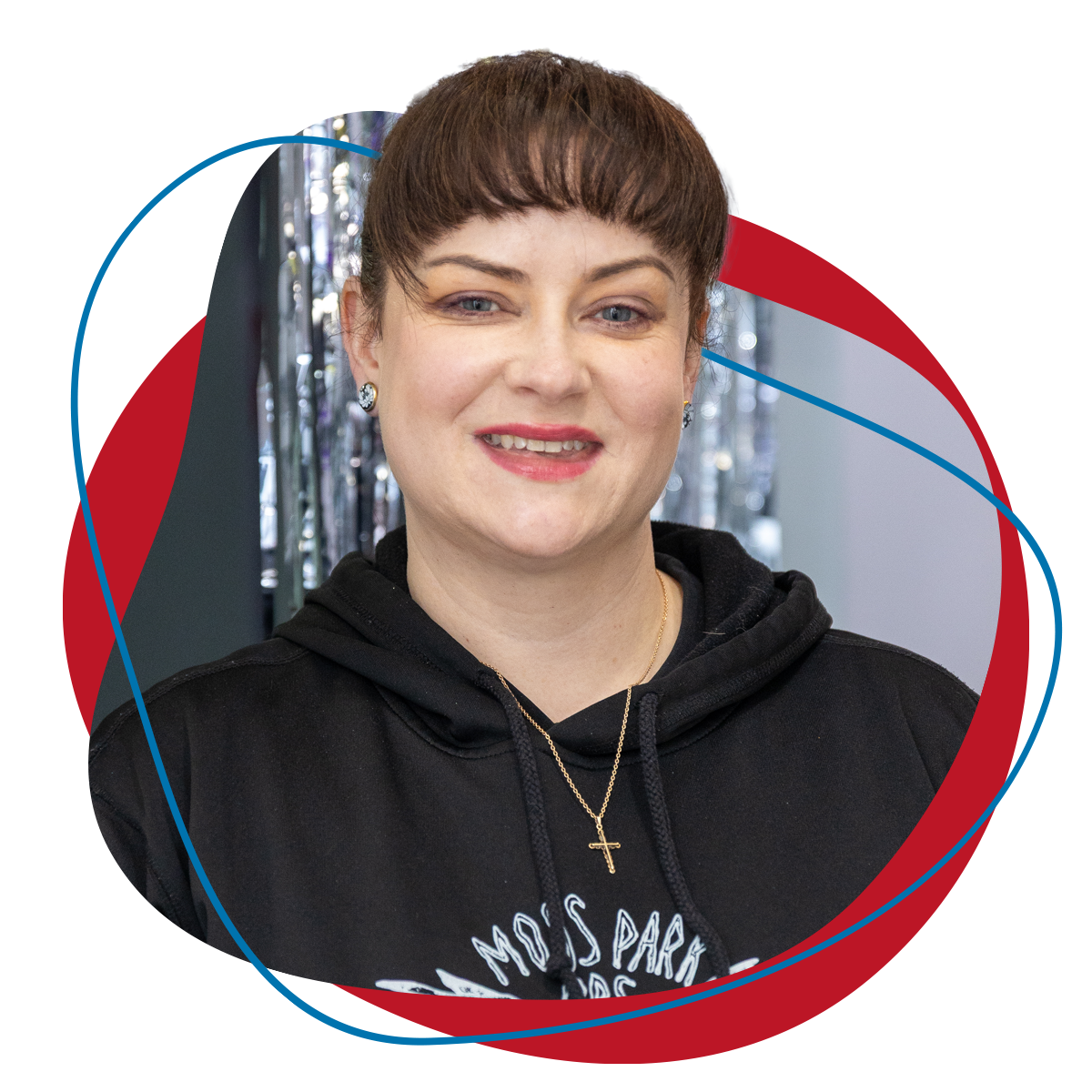
Erin Telegdi, a registered nurse of 13 years and Manager of Advanced Clinical Practice for Substance Use & Mental Health, leading clinical innovation in community health care
What first brought you to SRCHC and what made you stay?
I was first introduced through my work with their Moss Park Overdose Prevention Site, back when it was an unsanctioned service in the park. My introduction was really through the frontline workers and community who were doing incredible work together, and who were kind enough to bring me along for the journey.
When Moss Park was adopted by South Riverdale to become a sanctioned supervised consumption treatment service (CTS), and the opportunity came up to work as a nurse there full-time, it felt like a no-brainer.
Your work has grown from frontline care to shaping systems. How did that journey unfold?
Because we were building a pretty unique program — and it was a satellite site — there was a lot of work needed to create the systems that became the Moss Park CTS.
I completed a Registered Nurses’ Association of Ontario Advanced Clinical Practice Fellowship, which gave me time to really think about the work nurses were doing at the site. We developed a philosophy of care, and we did quality improvement surveys with community members asking how they wanted to receive care, what they were hoping for, what they liked, and what they wanted more or less of.
That project was really illuminating. It got me thinking more about systems-level work and program design and eventually led me back to school. I’m now one month away from completing my Master of Nursing.
I’ve since moved into an Advanced Clinical Practice role in Substance Use and Mental Health at SRCHC. What’s really exciting is that roles like this are common in hospitals, but much less so in community health care. It’s very forward-thinking that SRCHC saw the value in having clinicians help build systems of care.
One of my goals in this role is to highlight and amplify the incredible expertise and quality of care happening in community so it gets the recognition it deserves.
When you think about care, what does it mean to you?
One of the fundamental values I work from is that healing happens in community. That’s the power of community health centres — their unique way of working in, with, and for community.
For me, care means being in community. It looks like people caring for each other, centering relationship, and building structures through programming and evaluation that support people to live their healthiest lives, wherever they’re at.
Can you share a moment when you felt truly seen, valued, or cared for at SRCHC?
Honestly, the community I work with at the Moss Park CTS makes me feel seen, valued, and cared for all the time. That’s a big part of what has cemented my commitment to this work.
There’s so much reciprocity of care, and people have always been incredibly generous in including staff in that sense of community. I can’t point to just one moment. It’s the accumulation of many big and small moments, all the time, just being in community together.
As you imagine SRCHC 50 years from now, what do you hope people will feel when they walk through the doors?
I hope people feel like they can be who they are — that they’ll be met with care and compassion, that they’ll be heard, and that their contributions are valued as a fundamental part of how we build our future.
We’re going to keep community health care strong. We’re going to fight for it and continue to show how fundamentally important it is.