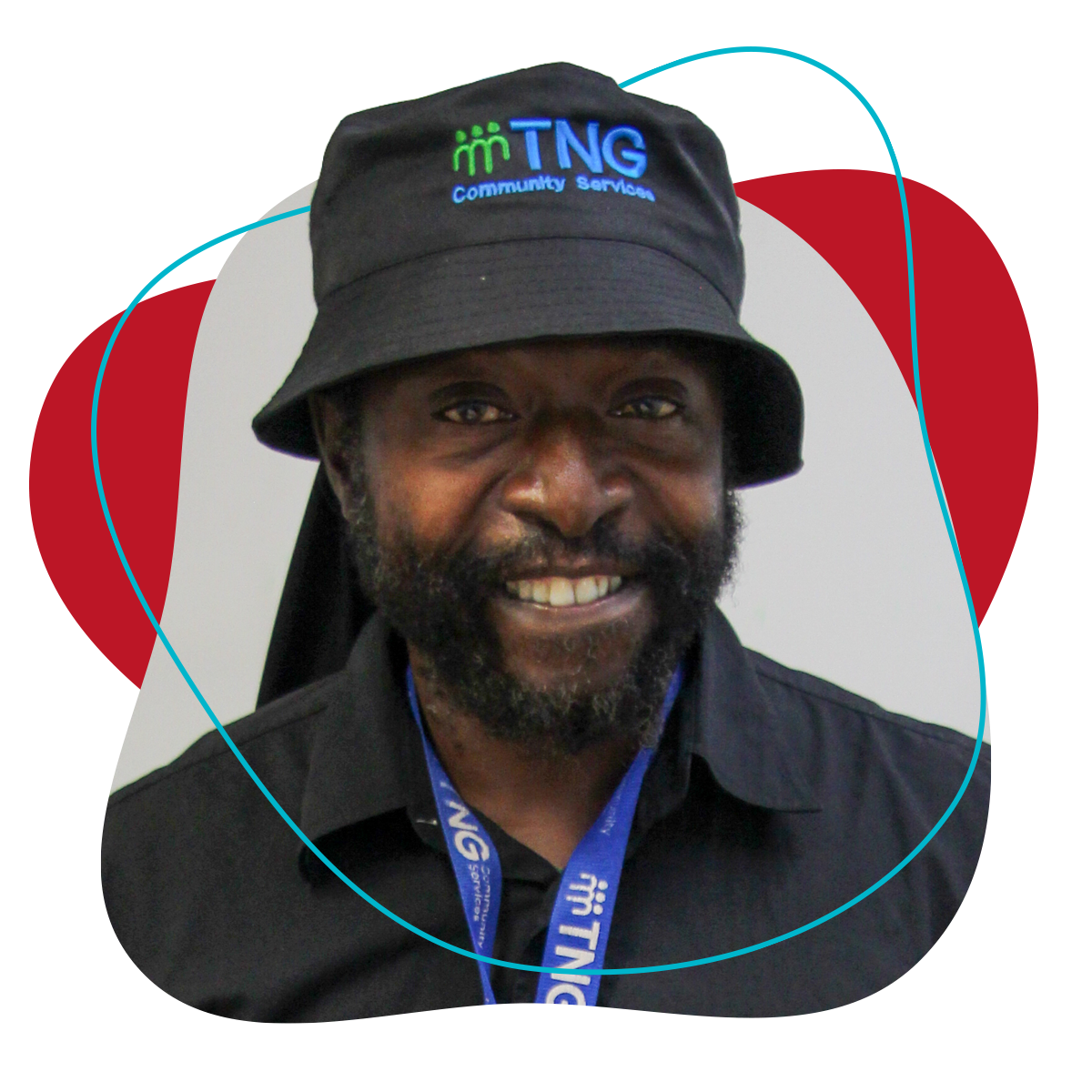
Through his work and art, Patrick Esenerwa creates opportunities for people to feel supported and imagine a different future.
Every path into community healthcare begins somewhere. Looking back, what experiences or values led you to your work, and what continues to inspire you today?
Experiencing homelessness led me to social work, realizing we have a crisis that needs all our input to come up with solutions.
I’m in my fourth year in Canada and it has been a new learning curve, considering I came from a completely different society and culture. When I arrived in Toronto, experiencing homelessness, substance use, and mental health challenges made me acknowledge that when these factors come together, it becomes a crisis for society.
I started as a peer support worker, currently working as a Case Manager with TNG Community Services and as part of the Toronto Community Action Team at the East Toronto HART Hub. My work is about supporting people with complex needs and helping them find ways to move forward — whether that is housing, employment, or other supports.
If you’re not housed, you’re not stable and secure. Because I have experienced that myself, I understand how important it is to have someone to support you.
You’ve had the opportunity to walk alongside many people on their journeys. Can you share a moment that has stayed with you and why it continues to resonate?
There is one very emotional moment that has stayed with me for a long time.
There was a client who was homeless at the peak of winter season. She was living on the streets by A&W, sleeping in the cold. Through our Winter Support Program, I was able to find her a safe bed.
Once we connected and built the trust, I was able to help her do her taxes, get her ID, and get her signed into the Access to Housing portal. I also connected her with an Indigenous worker. Eventually, she got housing.
With housing and the right supports, her life was transformed. That is something I will remember for a long time.
So much of your work is about building trust and relationships. What has been one of the most meaningful or rewarding parts of the work you do?
Getting people access to housing, definitely.
Then the next big thing is helping people find purpose — a job.
I helped two of my clients get started with peer support programs at TNG. One joined the Mobile Shelter Support Program and the other joined the Integrated Prevention & Harm Reduction Initiative. We wrote references for them and they managed to get in. That was incredibly rewarding for me.
Sometimes, even when you don’t have housing, if you have good employment, you can support yourself and pay something toward housing.
So, I would say the best part of my work is giving people a safe space to find ways to move forward — finding housing, finding employment, and finding purpose.
In addition to your work at the East Toronto HART Hub, you’re also a talented artist. How has your creative practice evolved over the years?
My art has evolved to include more social justice themes, with a focus on Toronto. I’m trying to communicate some of the challenges that we are facing.
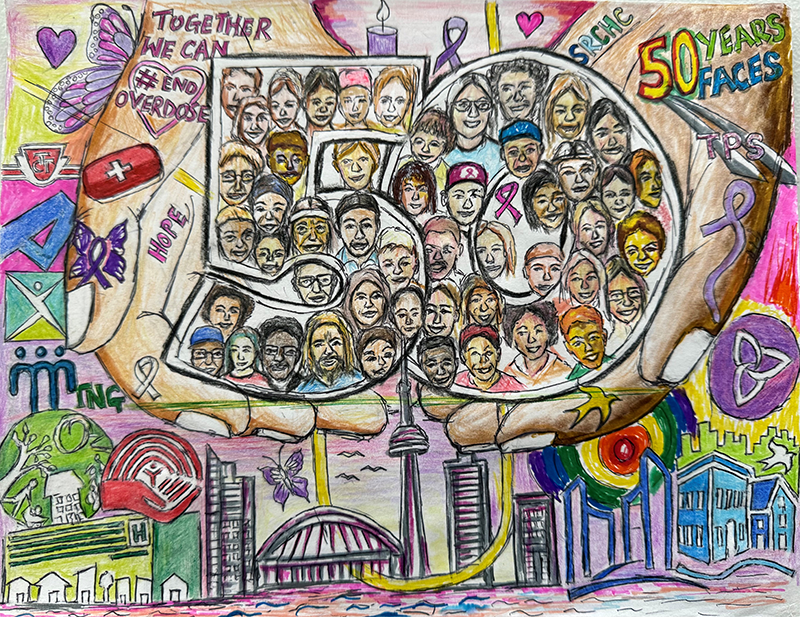
At the same time, I’ve started doing manageable projects with clients, like colouring images. We create black-and-white sketches and prints. They paint and colour them how they feel and like to create the compositions, and then we make collages from the artwork.
I want to do more research around this and show my commitment to social justice. I want to do a Fine Arts PhD thesis about homelessness, substance use, and mental health challenges.
I’ve started collecting information about how clients’ situations change when they interact with art or create art. We look at it through observation, questionnaires, and photographs. Even these small projects are part of the data collection.
Through your work, you collaborate closely with South Riverdale Community Health Centre. What has that partnership meant to you and what have you appreciated most about working together?
The partnership means a lot.
There are many smart brains coming together at the East Toronto HART Hub from different organizations. Everyone brings different resources and different knowledge to help with the different crises we are seeing.
When we coordinate our efforts and work together, we can have more impact. That is what I appreciate most.
Dreaming Forward, what do you hope organizations like SRCHC can help make possible over the next 50 years — for individuals, for communities, and for the future of care?
Housing.
If SRCHC can work together with partners to set up affordable housing for people, that would be very good. Community housing. Housing supports for people who need them.
I would also like to see harm reduction knowledge become available to everybody, or at least become more friendly and easier to understand, because a lot of people don’t know what harm reduction is.
Harm reduction is not just about drugs and needles. Anything that is supportive can be harm reduction.
Even creating art is a form of harm reduction.