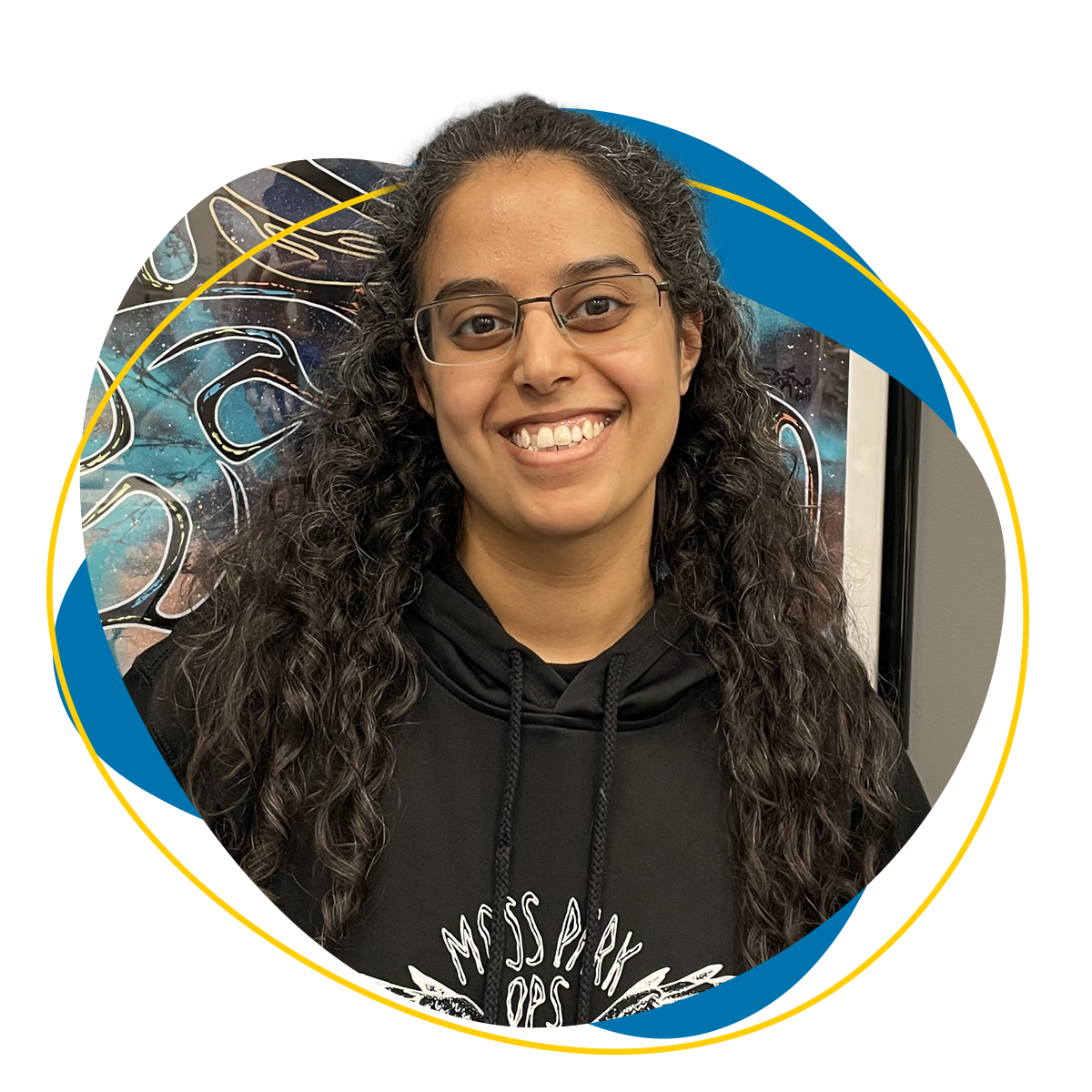
Lamia Nouman, a passionate Community Health Worker who champions cultural inclusivity and a sense of belonging
How did your journey with SRCHC begin?
I started my career in pharmacy. As a placement student, I saw the limits of only using a medical model. We focused on patients’ physical health, but many people needed more than we could offer. They needed social services, too — and we couldn’t provide that.
I wanted to do more, so I completed a certificate in Addictions and Mental Health at Humber College. After graduating, I started looking for work in the field. The holistic approach at South Riverdale Community Health Centre really appealed to me, along with its strong focus on diversity and equity.
What drew you to SRCHC’s commitment to diversity and equity?
That was something I really wanted to bring into my community work. As a Muslim, I think about how many people in my community are shunned because they use substances or are struggling with mental health.
I wanted to help create more culturally safe and inclusive spaces for Muslims accessing services — to be a foot in the door for that change, and to create more safe spaces for Muslims who don’t have that.
I try to create small moments of connection, too — saying “Happy Ramadan” or “Eid Mubarak,” or bringing treats to share. When you’re isolated from your community and the things that feel familiar, it’s really hard. Those small gestures can mean a lot.
What does care look like to you, in your day-to-day work?
Through my community health work at SRCHC — especially at the Moss Park site — I’ve really expanded my understanding of care. It’s not just asking, “Have you gone to your appointment?” or “Have you taken your meds?”
It’s also asking, “Have you slept? Have you eaten? Do you want to talk?” That basic human connection is often overlooked.
When I’m providing care, I focus on what the person needs in that moment — whatever I can help with. I don’t come in with predefined goals. People tell me what they need, and I try to support them using the resources we have.
I’m also learning to be more patient and to understand that healing isn’t linear. Going with the flow is a big part of it. If something doesn’t work out, that’s okay. We’ll figure something else out.
That’s one of the harder parts of care, too: staying calm and grounded. You want people to succeed, and it’s important not to catastrophize when things don’t go as planned.
When you imagine SRCHC 50 years from now, what do you hope people will say?
I hope people will still see it as a place that leads with a holistic, relational model of care — like what we offer at the Moss Park site. Care that’s open-minded and not paternalistic.
I’d love to see that approach continue to grow across SRCHC, and being low-barrier and accessible for everyone who needs it.
Bringing cultural awareness and inclusivity to the forefront will always be important, so no one feels left out.
That’s what I picture when I think about the future.